

A weekly scorecard for small business is a short list of numbers (usually five to fifteen) that you review every single week to see whether the business is on track. Each number has an owner and a goal. It tells you what's working, what's slipping, and where to focus, without you having to be in the middle of everything to find out.
That's the definition. Now let's talk about why you probably don't have one.
Most owners I meet know how their business is doing the same way you know a storm is coming. You feel it. Something's off, the inbox is louder, cash feels tight, and you can't quite put your finger on why.
That's not a system. That's a gut feeling with a mortgage attached.
Why Running Your Business on Gut Feel Keeps You the Bottleneck
When the only way to know what's happening is to be in the middle of it, you become the dashboard. Every question routes to you because you're the only one holding the full picture.
And here's the part nobody tells you: if the business can't report on itself without you, it can't run without you either.
A weekly scorecard fixes that. It takes the picture out of your head and puts it somewhere everyone can see it. Sales, marketing, delivery, cash, people. A handful of numbers, one page, reviewed the same time every week.
It's not fancy. It's not a 40-tab spreadsheet you built at midnight and never opened again. It's the opposite of that.
Does This Sound Like Your Business?
If you're nodding along to two or more of these, you need a scorecard.
You find out about problems after they've already cost you. The slow month shows up when the bank balance does, not three weeks earlier when leads dried up.
Your team gives you updates, but not numbers. "It's going good" is a vibe, not a report.
You check five different apps to answer one question. Your CRM, your bank, your project tool, your inbox, and a sticky note.
You can't step away without anxiety. Because if you're not watching, nobody is.
Meetings turn into storytelling sessions. Everyone talks, nobody's sure what's actually on or off track.
You're "busy" but can't say whether this week was a good one. Busy and productive are not the same thing.
Why Working Harder Won't Give You Visibility
When things feel foggy, most owners respond by leaning in harder. More check-ins. More "just looping you in" messages. More late nights reviewing everything personally.
I get it. But more effort doesn't create more clarity. It just creates a more tired version of you holding the same blurry picture.
Here's what actually happens when you try to muscle your way to visibility:
You become the only person who can tell whether things are working. Your team stops tracking their own results because you'll catch it anyway. And you spend your best hours asking questions a one-page scorecard could have answered in ten minutes.
Picture an owner with a team of four. Every Monday she spends the morning chasing updates across Slack, email, and her project board. Death by a thousand slacks. A simple scorecard turns that morning into a short review instead of a scavenger hunt.
That's the shift. You stop being the dashboard. The scorecard is the dashboard.
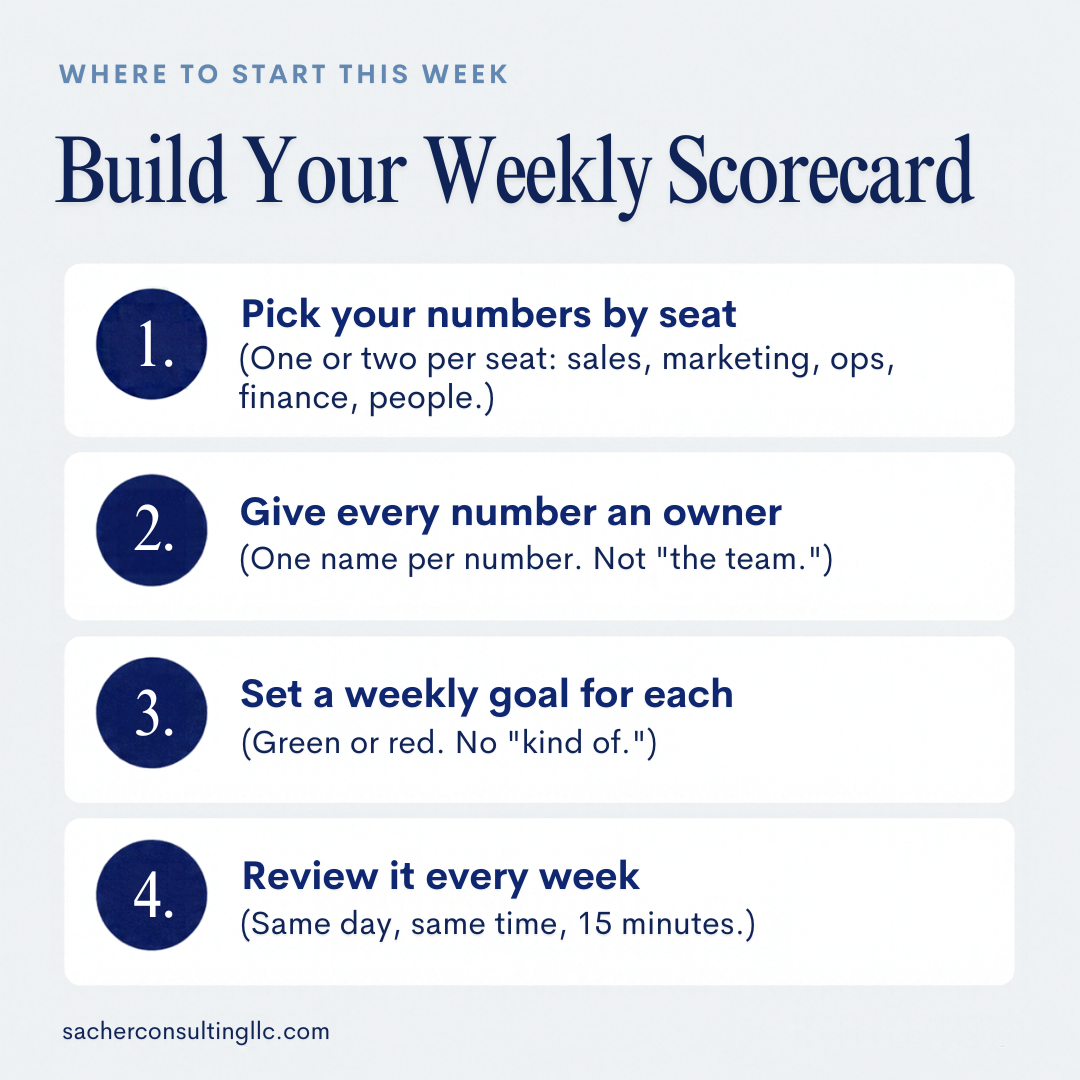
How to Build Your Weekly Scorecard: Where to Start This Week
You don't need software. You don't need a consultant (okay, it helps, but you can start without one). You need a page, a few numbers, and the discipline to look at them every week.
1. Pick your numbers by seat, not by panic
Look at your org chart, and remember, it's seats, not people. Sales, marketing, operations, finance, people. Choose one or two numbers per seat that tell you whether that part of the business is healthy. Think leads booked, proposals sent, projects delivered on time, cash in the bank, open invoices. If a number wouldn't change a decision, it doesn't belong on the scorecard.
2. Give every number an owner
Each number gets one name next to it. Not "the team." Not "us." One person who's responsible for reporting it and for raising a flag when it's off. If you're a team of one, that name is yours for now, and that's fine. You're still building the habit.
3. Set a weekly goal for each number
A number without a goal is just trivia. Decide what "on track" looks like each week, then mark every number green or red. No yellow, no "kind of." Either it hit the goal or it didn't, and if it didn't, we talk about it.
4. Review it at the same time every week
Put it on the calendar. Same day, same time, ten to fifteen minutes. Look at what's red, ask why, and decide what happens next. Don't solve everything in the meeting; just make sure every red number has a next step and a name.
Your Business Can Look Like This
Imagine opening one page on Monday morning and knowing, in ten minutes, exactly how last week went.
You see that leads are up and proposals are behind, so you know where to nudge. Your team shows up already knowing their numbers, because they own them. Nobody's waiting on you to tell them whether things are okay.
You stop managing by feel and start leading by facts.
You take a long weekend and the business keeps moving, because the scorecard is still being filled in and reviewed whether you're in the room or not. You make decisions from the numbers instead of from whatever fire happens to be loudest.
That's what structure gives you. Not more control. More freedom.

Ready to Stop Guessing? Let's Build Your Scorecard
If you've read this far, you already know your business deserves better than gut feel. Start with the four steps above this week. Even a rough scorecard beats no scorecard.
If you want help building one that actually fits your business (the right numbers, the right owners, and a meeting rhythm that sticks), that's exactly what I do.
Clarity first, freedom follows.
