
Build Your Small Business Org Chart by Seats, Not People
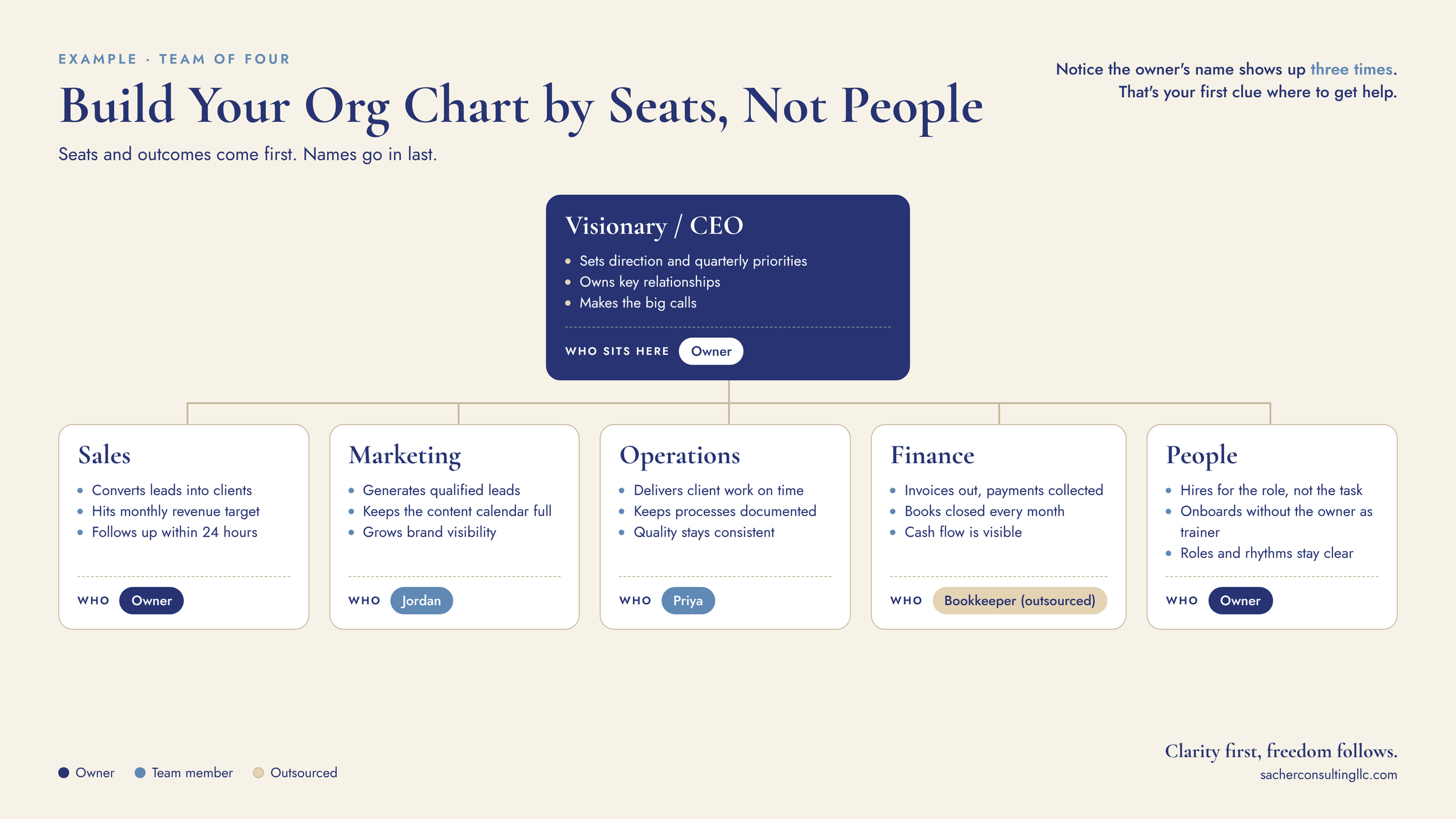
A small business org chart should map seats, not people. A seat is a role with clear outcomes, like sales, marketing, operations, finance, or people. Start by listing every seat your business needs, then write whose name goes in each one. Even a team of one fills multiple seats, and a seat can say "outsourced."
Now let me tell you why this matters so much.
I work with women business owners every week as a fractional COO, and one of the first things I ask for is the org chart. Usually I get one of two answers. Either "we don't really have one," or a neat little diagram with the owner at the top and everyone else in boxes underneath.
Here's the thing. The second one isn't much better than the first.
Because if every box is just a name, nobody knows what they actually own. And when nobody knows what they own, guess who becomes the answer to every question? You.
Why Most Small Business Org Charts Don't Work
Most org charts are built around the people you already have, not the work the business needs done. That's why they don't change anything.
When you build a chart around people, you end up drawing boxes around whoever happens to be on payroll right now. Sarah does "admin stuff." Jen does "marketing and some client things." You do everything else.
That's not structure. That's a guest list.
The problem is that people-first charts hide the gaps. If nobody is clearly responsible for finance, you won't see it on a chart full of names. You'll just feel it, every month, when you're the one chasing invoices at 10pm.
And they hide the overlaps, too. Two people half-owning the same thing usually means nobody fully owns it. Then it lands back on your desk.
If the business can't run without you, you don't own a business. You own a job. A people-first org chart quietly keeps it that way.
What Is a Seat on an Org Chart?
A seat is a defined role with three to five clear outcomes it's responsible for, no matter who sits in it. People change; seats stay.
Think of it like a dining table. The chairs are there before anyone sits down. You decide how many you need based on the meal, not based on who showed up.
Every business, regardless of industry, has the same core seats:
Sales: bringing in new clients and revenue
Marketing: getting attention and generating leads
Operations: delivering the work and keeping it consistent
Finance: money in, money out, and knowing your numbers
People: hiring, onboarding, and supporting the team
Some businesses split these further, some combine them. The point is that each seat has a short list of things it owns. Not tasks. Outcomes.
"Posts on Instagram three times a week" is a task. "Generates enough qualified leads to fill the calendar" is an outcome. Write seats in outcomes, because outcomes are what let someone else actually own the result.
How to Build an Org Chart for a Team of One
If you're a solo owner, your org chart has five or more seats, and your name is in all of them. That's not a failure. That's the starting line.
I love doing this exercise with solo owners, because the moment they see their name written five times, something clicks. You're not "just busy." You're doing five jobs. Of course you're tired.
Seeing it on paper does two things.
First, it makes the load visible. So much of what owners carry is unseen, and the unseen work is the real work. Naming the seats gives that work a shape.
Second, it shows you where to get help first. Look at each seat and ask: which one drains me most, and which one could someone else do well? That's usually your first hire, or your first outsource.
And yes, a seat can say "outsourced." Your bookkeeper can sit in part of the finance seat. A virtual assistant can sit in part of operations. You don't need a full-time employee to fill a seat; you need someone accountable for its outcomes.
Build for Where You're Going, Not Where You Are
Your org chart should reflect the business you're building, not just the one you have today. Draw the future version first, then fill in today's names.
One of my clients, a team of four, had an org chart that looked tidy until we asked what it would take to double revenue. Suddenly there were seats that didn't exist yet, and two people stretched across roles that would each need a full person.
That's exactly what you want to see. Once the future seats are on paper, hiring stops being reactive. You're not hiring "someone to help with stuff." You're hiring for a specific seat with specific outcomes.
This is the difference between hiring for the role and hiring for the task. Task hires get handed scraps. Role hires get handed ownership.
Seats Make Delegation Actually Stick
When every seat has clear outcomes, you can delegate ownership instead of tasks, and that's what finally gets you out of the middle.
Here's what usually happens without seats. You hand someone a task. They do it. Then they come back for the next one, because they don't know what they own beyond that one thing. You're still the hub. It's delegation with extra steps.
With seats, the conversation changes. "You own the operations seat. These are the outcomes. Here's the authority to make calls inside it." Now they can make decisions, including ones you'd have made differently.
That last part matters. Responsibility without authority is just blame you can't hand back. If someone owns a seat, they need the power to run it.
Where to Start This Week
You don't need a consultant or a fancy software tool to start. You need a blank page and about an hour.
List your seats. Write down sales, marketing, operations, finance, and people. Add any seats specific to your business. Don't write names yet.
Give each seat three to five outcomes. Write what the seat is responsible for producing, not the tasks it does. If you can't name the outcomes, that's a sign the seat has been running on autopilot (or on you).
Then add names, honestly. Put the real person in each seat today, including yourself as many times as needed, and mark anything outsourced. Circle the seat you'd hand off first. That's your next move.
Clarity First, Freedom Follows
An org chart built on seats isn't about being corporate. It's about finally seeing your business clearly enough to stop holding all of it.
If you want a head start, grab the free tools on my resources page. And if you'd rather build this with someone who does it every week, book a discovery call and let's map your seats together.
Build the chairs first. Then decide who sits down.