

How to Escape the Founder Bottleneck in 5 Systematic Steps
You started your business to build something that mattered, not to become the person every decision waits on. Yet here you are, approving the same requests, answering the same questions, and fixing the same problems week after week. If growth feels heavier instead of easier, you are not failing. You have simply outgrown the way your business currently runs. The technical name for what is happening is the founder bottleneck, and it is one of the most common reasons capable, in-demand businesses stall right when they should be scaling.
The good news is that a bottleneck is a structural problem, not a personal one. It can be diagnosed, and it can be dismantled. Here is how to tell whether you have become the constraint, why it happens to even the most driven founders, and the system-by-system approach that frees you to lead instead of manage.
What is a founder bottleneck?
A founder bottleneck happens when too much of your company's knowledge, decision-making, and quality control lives inside one person's head: yours. As long as that is true, your business can only grow as fast as you can personally process work. You become the central hub every task routes through, and every hour you are unavailable is an hour the business slows down.
This is not a sign that you are doing a bad job. It is usually a sign that you have done a very good job. You built demand, you set the standard, and you earned your clients' trust by being involved in everything. The same instinct that got you here is now the thing holding you back. Research from Harvard Business Review has cited that founders spend nearly 68 percent of their time on operational work rather than strategic growth, and that imbalance becomes a hard ceiling as a business matures.
Does this sound like your business?
Most founders feel the bottleneck long before they name it. See how many of these sound familiar:
Your team waits on you. Work sits idle until you weigh in, approve, or unblock it, and your inbox is the busiest intersection in the company.
Decisions pile up around you. The same types of questions come back to you over and over because the answer lives in your head, not in a documented rule.
You cannot fully unplug. A few days away creates a backlog that takes a week to recover from, so real time off feels impossible.
Quality drops when you step back. When you are not personally checking the work, standards slip, which keeps pulling you back into the details.
Growth feels like more chaos, not more freedom. Every new client or hire adds weight instead of leverage, because there is no structure to absorb it.
If three or more of these ring true, you are not short on effort. You are short on systems.

Hi, I’m Elle!
I help ambitious female founders move from chaos to clarity—building systems that scale and teams that perform without constant oversight.
Working harder only makes it worse…
The instinctive response to a bottleneck is to push harder: longer hours, faster replies, more personal oversight. That works for a while, and then it quietly backfires. Every time you solve a problem personally instead of building a way for it to be solved without you, you reinforce the dependency. The business learns to rely on you even more, and the ceiling gets lower, not higher.
Businesses do not scale because their leaders work endlessly. They scale because their operations become repeatable, transferable, and sustainable. The shift that unlocks the next stage of growth is not doing more yourself. It is designing your business so the right things happen consistently whether or not you are in the room.
5 Steps Toward Freedom:
Escaping the bottleneck is not about delegating randomly or hiring and hoping. It is about systematically moving work out of your head and into structures your team can run. Here is the sequence that works:
1. Run a Decision Audit
Start by making the invisible visible. Look back over the last ninety days and list the decisions and approvals that ran through you.Identify the twenty or so that repeat most often. For each one, capture the trigger that starts it, the information needed to decide, the rule you actually apply, and what a good outcome looks like. This audit turns the vague feeling of being overwhelmed into a concrete, prioritized list of the systems you need to build.
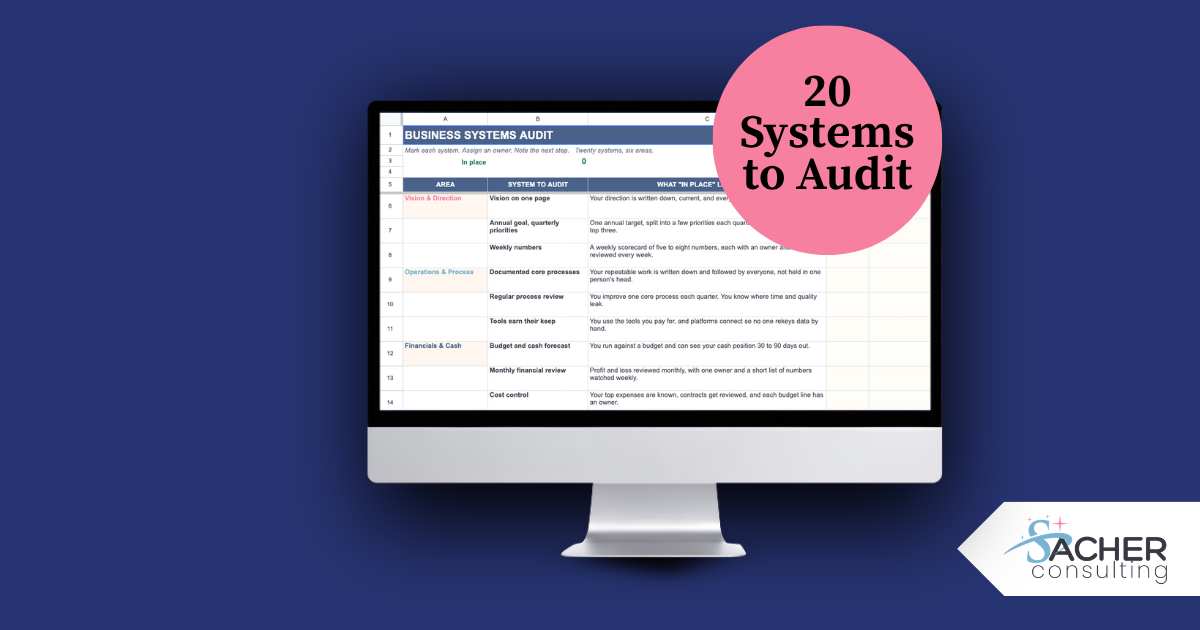
Business Systems Audit
The audit covers six areas. The first two decide whether the business has a direction, and whether the work can happen without you standing over it.
2. Document the Repeatable Work
Take the highest-frequency items from your audit and turn them into simple, usable processes. The goal is not a binder no one opens; it is a short, clear playbook your team can follow without asking you. Document the workflows that happen again and again, from client onboarding to billing to routine approvals, so the knowledge lives in the business instead of in your memory.
3. Delegate Outcomes, Not Just Tasks
Most delegation fails because founders hand over a checklist and then hover. Real delegation means handing over a result. Describe the goal, give enough context that your team understands why it matters and what success looks like, and define the boundaries within which they can decide on their own. When people own outcomes rather than steps, they stop coming back to you for every small turn.
4. Replace Oversight With Metrics
You stepped into the details because that was the only way to know things were on track. Replace that instinct with data. A small set of key performance indicators gives you visibility into what matters without requiring you to personally inspect the work. When the numbers are healthy, you can stay out. When a number drifts, you know exactly where to look. Metrics let you lead by exception instead of by constant supervision.
5. Build a Team That Self-Manages
The end state is a team that solves problems at the level where they happen. That comes from clear roles, clear ownership, and clear accountability, reinforced over time. As your systems stabilize and your people grow into their authority, the business starts to run on structure rather than on your presence. That is the moment scaling stops feeling like chaos.
Your future can look like this:
When work no longer routes exclusively through you, the whole business breathes differently. Your team moves faster because they are not waiting for answers. Quality holds steady because standards live in your systems, not just in your head. You finally get to spend your time on the strategic decisions only you can make, the ones that actually move the business to its next level. And you can step away without everything unraveling, which is the real definition of a business that has matured past its founder bottleneck.
This kind of change does not happen overnight, and it does not require you to work even harder. It requires structure, the right priorities, and the discipline to build systems instead of carrying everything yourself.
Ready to Find Your Bottleneck?
If you recognized your business in this article, the first step is clarity on exactly where it still depends on you. That is the work I do as a Fractional COO: stepping inside your business to build the systems, structure, and accountability that let it scale without burning you out. If you are ready to get out of the weeds and lead with confidence, let's build your growth plan together.